LinkedIn Outreach in 2027: A Step-by-Step Sequence That Books B2B Calls
A LinkedIn outreach sequence that books calls is a short, paced set of touches. Here is the full sequence, step by step, plus where extra senders and channels fit.

Need accounts to run this playbook? Enquire Now
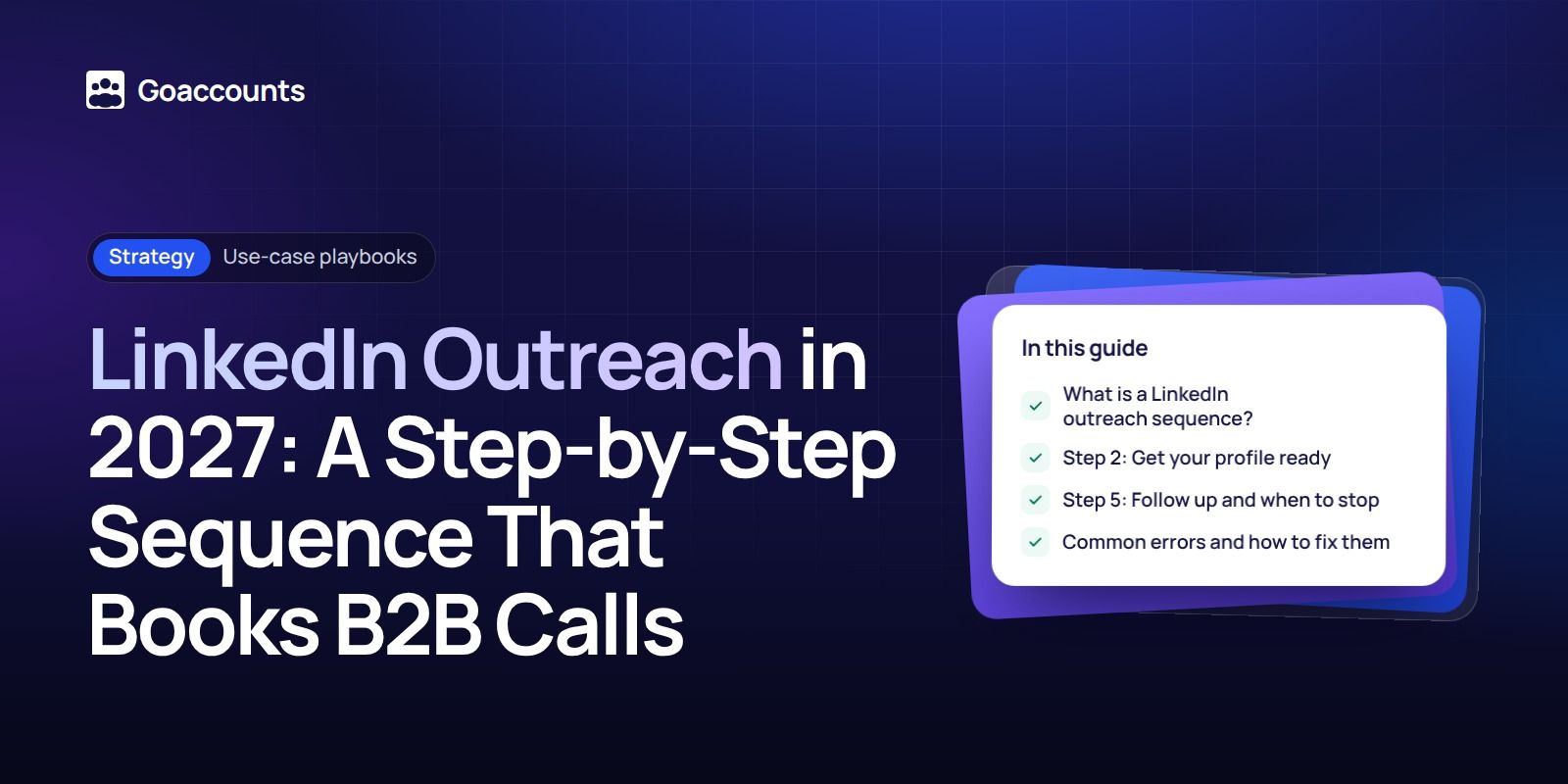
A LinkedIn outreach sequence that books calls is a short, paced set of touches: build a tight list, ready your profile, send a connection request, then one short message when they accept, then two or three spaced follow-ups, moving to email or a call where it fits. When one profile hits its weekly limit, you add senders, not volume. This guide walks the whole sequence for 2027.
What is a LinkedIn outreach sequence?
A LinkedIn outreach sequence is a planned series of touches that moves one person from a cold profile to a booked call, paced to the platform's limits. It is a repeatable order of steps you run for every prospect, so you can see what works and run it at volume.
The whole shape is nine beats: build a list, ready your profile, send the request, send the first message, follow up two or three times, add a channel where it fits, make the ask, respect the weekly ceiling, and add senders when you hit it. Most guides stop at the follow-up. The two they skip, the weekly ceiling and adding senders, are exactly where people get stuck. This guide covers all nine.
By the end you will have a sequence you can run, and a clear point for when one profile is not enough. You need a tight list, a human-looking profile, and a budget if you will run it across more than one account.
Step 1: Build the list and decide whose profile sends
If you'd rather not risk your own profile, sign up at GoAccounts and get aged, ID-verified LinkedIn accounts in 3 to 10 days, depending on how many accounts you need.
A sequence is only as good as the list under it. Most cold outreach gets no reply: in recent vendor benchmarks of millions of requests, acceptance ran roughly 18% to 29%, and only a fraction of those replied. So a tight list of the right people beats a big list and a clever template.
Before you write a word, decide two things. Who you are messaging: a narrow list of people who have a reason to care. And whose profile sends: your own and your team's real profiles, or separate accounts kept apart from your personal network. Your own profile is cheaper but puts your network and reputation on the line if an account gets restricted. Make this call first; it shapes every step after.
Step 2: Get your profile ready
The account doing the sending has to look like a real person before it sends anything. A sparse profile, or one that starts sending at volume on day one, is the most common reason a new account gets restricted early. Expected result: a complete profile with a photo, a clear headline, a filled-out About and some real activity history.
Warm it before you push it. An account with 500 or more real connections and normal activity can start sooner than a cold one, which has to ramp first, posting, commenting and connecting at a low pace before it runs a full sequence. If you rent managed accounts, the warm-up is already done; if you build your own, budget the time.
Step 3: Send the connection request, note or blank?
Here the guides argue, and the honest answer depends on a limit most get wrong. A connection-request note is capped at 200 characters, not 300, and on a free account you can add a personalized note to only three requests a month. Premium lifts that note cap.
So note-or-blank is partly a quota decision, not only a reply-rate one. Some operators send a short, specific note that earns the accept. Others send blank and save the note for after the accept, where there is no three-a-month cap. On a free account at volume you cannot personalize every request, so plan which ones get a note.
If you do write a note, keep it inside 200 characters and make it specific. This fits:
Saw your post on hiring SDRs without a playbook. I build those for B2B teams. Mind if I connect and share the one-pager I use?
That is about 130 characters and it sends. A 260-character version does not send at all, so you lose the slot and the accept.
Step 4: Send the first message after they accept
The first message after someone accepts is the one that matters, so make it short and give it one job. Keep it under about 400 characters, lead with why you are reaching out to them specifically, and end with one low-pressure ask rather than a pitch.
This is LinkedIn's own data, not an opinion. In LinkedIn's recruiter-InMail study of messages sent between May 2021 and April 2022, messages under 400 characters got responses 22% above average, and individually sent messages did about 15% better than bulk ones. Short, personal and one at a time wins.
Connect first, then message. Replies between existing connections run roughly three times better than cold Open InMail in recent vendor benchmarks, so InMail is a fallback for people you cannot connect with, not the opening move. A free account can message its connections, and reach some non-connections free through Open Profile; messaging most non-connections needs InMail on a paid plan, where monthly credits run from 5 to 50.
Step 5: Follow up and when to stop
Most people who book calls do it on a follow-up, not the first message, so plan two or three and space them out. A common pattern is a 14-day window with touches on days 1, 4, 9 and 14, each adding one new angle instead of "just following up", with the gaps widening as you go. The one rule that is not optional: stop the moment they reply.
That cadence is common practice, not a promise. Pair it with what LinkedIn actually publishes, which is less than the blogs claim. LinkedIn publishes no weekly invitation number. The limit exists and applies to everyone, and when you hit it, sending is restricted for what LinkedIn says is typically about a week. Sending more per day does not raise acceptance either: in one recent vendor benchmark, the heaviest senders (20 to 29 a day) were not the top band. A mid-volume band (10 to 19 a day) accepted best. Pace beats volume.
Step 6: Add email or a call where it fits
LinkedIn stays the main channel, but it does not have to be the only one. After the second LinkedIn follow-up with no reply, a short email or a quick call can fit, if you have their details and a reason to use them. Some outreach tools report that pairing LinkedIn with email lifts booking; treat that as a vendor claim, not a guarantee. The point is to give a quiet prospect one more easy way to respond, not to blast every channel at once.
Step 7: Ask for the call without being pushy
Book the call by making it the smallest possible yes: ask for a short, specific call, give one reason it helps them, and leave an easy out. A 15-minute call reads easier than a 30-minute demo. Something like this does the work:
If it is useful, I can walk you through how two or three teams your size run this in about 15 minutes. Worth a quick call next week, or not the right time?
It names a short length, gives a reason, and makes "no" a comfortable answer.
Step 8: Mind the weekly limit, and add senders
Here is the step the other guides skip. A good sequence still fails if you cannot send enough of it. LinkedIn publishes no weekly invitation number and no monthly search number, but both limits are real, and over-sending gets the account restricted. In practice, we pace one account to roughly 100 to 150 connection requests per week . That number is ours, not LinkedIn's.
So when your cadence is good and the only problem is "I cannot send enough," the fix is more senders, not a pushier message or one account pushed to 400 a week. To run 600 personalized touches a week, you need roughly four or five senders.
Be straight about the platform position. LinkedIn's User Agreement asks for one account in your real name, says not to share it, and says not to rent, lease or sell access or use unauthorized automation. Running or renting extra accounts and automating sits outside those terms and carries platform risk. No setup removes that risk, and anyone who promises an account that cannot be restricted is guessing.
A sender is also more than a login. Here is the order we build a working one in before it sends a single request : start with a warmed account that already has 500 or more real connections, match it to its own dedicated static ISP proxy, load it into its own GoLogin browser profile with two-factor through a portal, then connect it to the sending tool and check it runs. That is why you cannot just make five free accounts on one laptop: they would share an IP and a browser fingerprint, which ties them together.
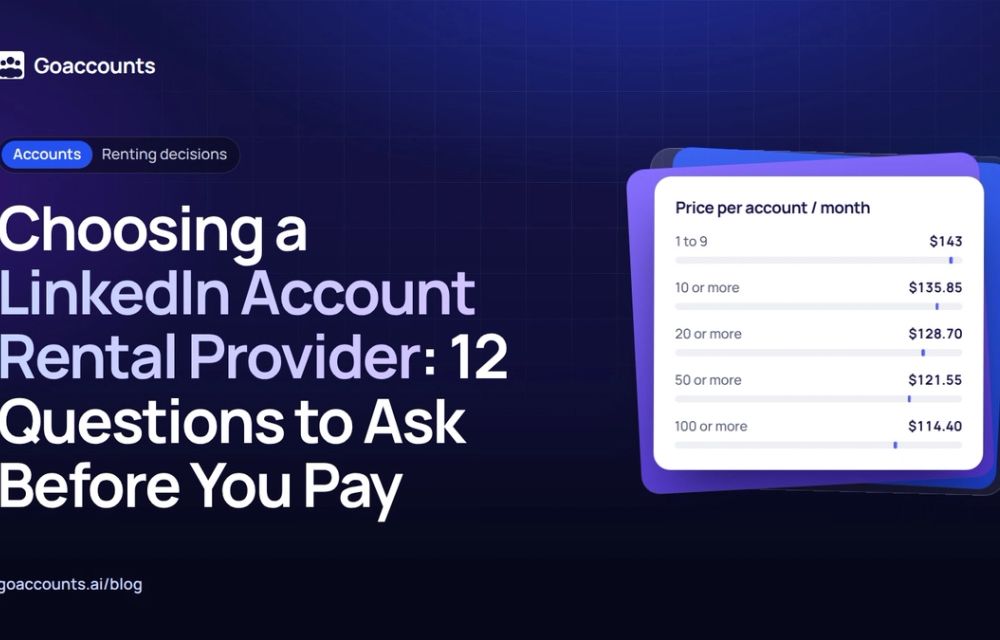
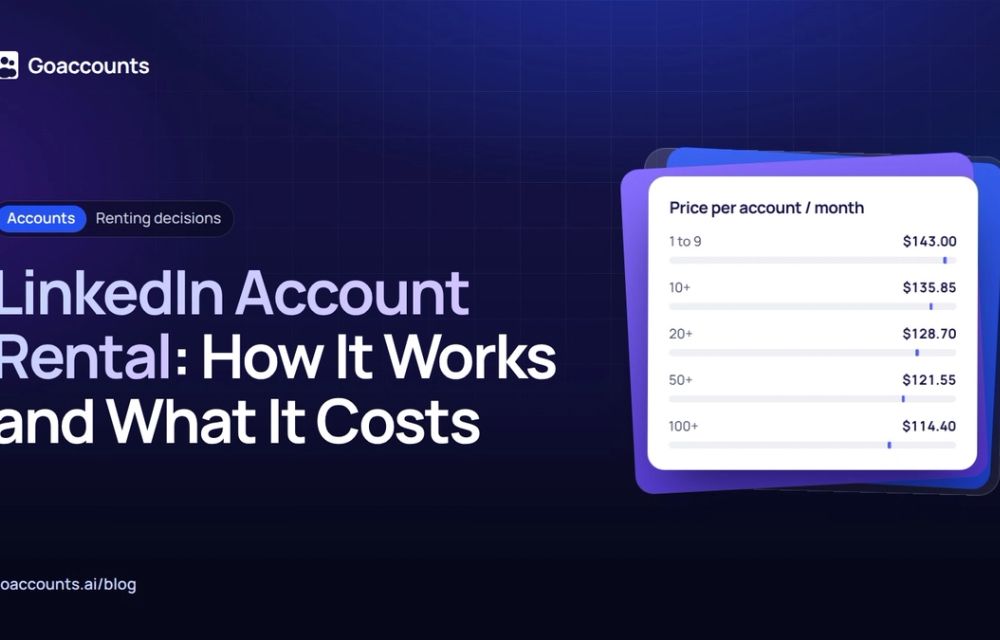
If building and warming senders yourself is more than you want to take on, renting is the low-setup way to add one. GoAccounts rents LinkedIn accounts from $143 per account a month, each with its own static ISP proxy, its own GoLogin browser profile and 500 or more real connections, month to month, delivered in 3 to 10 days. You can add Sales Navigator Advanced for $40 a month or Recruiter Lite for $98 a month per account, which raises the search and InMail ceiling. One account with the Sales Navigator add-on is $183 a month, all in, with proxy, browser profile and warm-up included; a restricted account is recovered or replaced within seven days. For the detail, see renting a LinkedIn account, scaling outreach across more than one account and what to do if an account is restricted.
Common errors and how to fix them
- Pushing one account harder when it slows down. Add a sender instead of raising the volume on a profile already at its ceiling.
- Treating "100 a week" as a LinkedIn rule. It is a vendor guess; LinkedIn publishes no weekly number. Pace to your own ceiling.
- Writing a 260-character note. It will not send. Keep it under 200 characters, or send blank and save the note for after the accept.
- Making the first message a pitch. Keep it under about 400 characters with one low-pressure ask.
- Carrying on after a restriction. Stop sending from that account and follow LinkedIn's recovery steps first.
FAQ
How many follow-ups should a LinkedIn outreach sequence have? Two or three over about 14 days is common practice, for example on days 1, 4, 9 and 14. Add one new angle each time and stop the moment they reply.
Should I add a note to the connection request or send it blank? Your call. A free account gets only three personalized notes a month, capped at 200 characters each, so at volume you cannot personalize every request. Many operators send blank and save the note for after the accept.
How many connection requests can I send a week? LinkedIn publishes no weekly number, and over-senders get restricted for about a week. We pace one account to roughly 100 to 150 a week, a pace we run to, not a line LinkedIn draws.
A sequence only works if you can send enough of it, and one profile caps out at a weekly limit LinkedIn will not even print. If that ceiling is your bottleneck, renting a sender with the proxy, browser profile and warm-up already done is the low-setup way to add one: see the pricing. To go deeper, work through our video course.
Researched and drafted with AI assistance from our team's notes, and checked against LinkedIn's Help Center, reply data and User Agreement on 2026-11-16 by the GoAccounts Team.